The Rise of the Ahmedabad–GIFT–Gandhinagar Technology Corridor
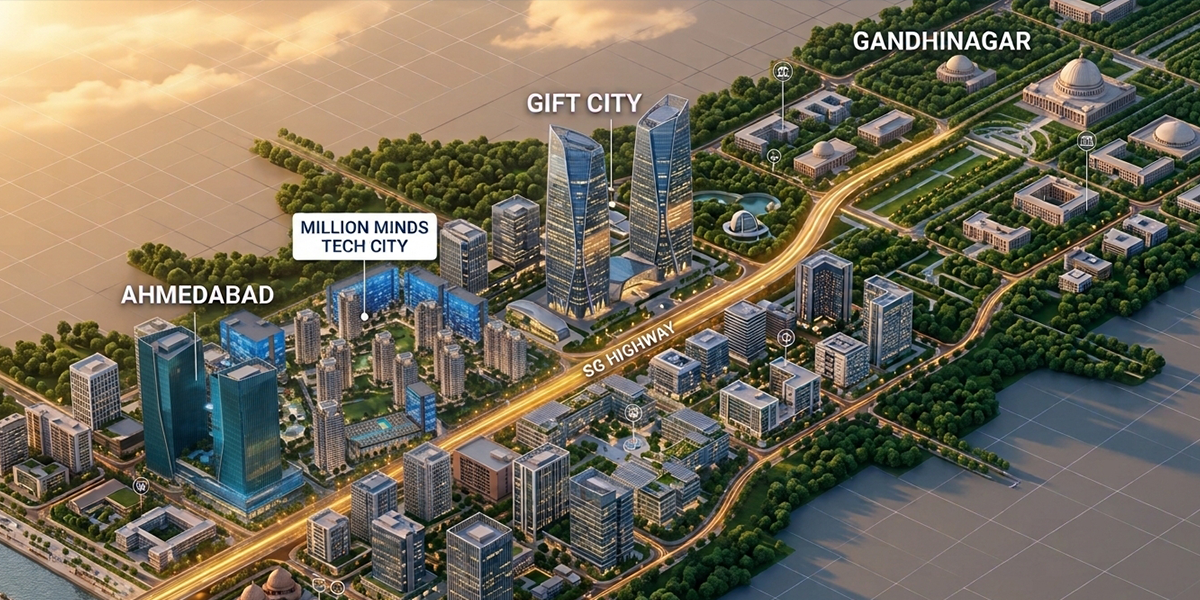
India’s next phase of enterprise growth will not be defined by isolated office towers alone. Instead, it will be driven by large, interconnected business corridors that combine infrastructure, policy support, talent ecosystems, urban development, and global connectivity.
One such emerging growth engine is the Ahmedabad–GIFT–Gandhinagar Technology Corridor.
Stretching across one of Western India’s most strategically positioned urban regions, this corridor is rapidly evolving into a major destination for:
For decades, Gujarat has been recognized for its strengths in manufacturing, trade, entrepreneurship, ports, and industrial development. Today, however, the state is entering a new chapter — one centered around technology, innovation, fintech, digital infrastructure, and global enterprise growth.
A Corridor Built on Economic Strength
The Ahmedabad–GIFT–Gandhinagar belt benefits from a unique combination of economic depth, urban momentum, and long-term infrastructure planning.
Each city within the corridor contributes a distinct strategic advantage.
Ahmedabad contributes:
Gandhinagar contributes:
GIFT City contributes:
Together, these three centers create a business ecosystem far more powerful than the sum of their individual strengths.
This is not merely a location advantage — it is a full-scale enterprise ecosystem advantage.
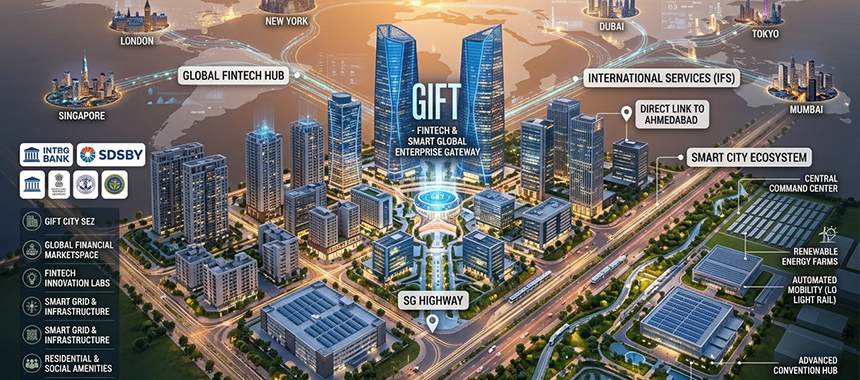
GIFT City’s Expanding Influence
GIFT City has played a transformative role in reshaping Gujarat’s enterprise identity.
As India’s first operational smart city and international financial services hub, GIFT City has attracted:
Its rapid growth is creating a strong spillover effect across the broader Ahmedabad–Gandhinagar region.
Today, companies evaluating GIFT City are also assessing the surrounding ecosystem for:
This broader ecosystem is becoming increasingly important because modern enterprises no longer evaluate office locations in isolation.
They evaluate the complete operating environment.
Questions companies now ask include:
The Ahmedabad–GIFT–Gandhinagar corridor is beginning to answer these questions with growing confidence.
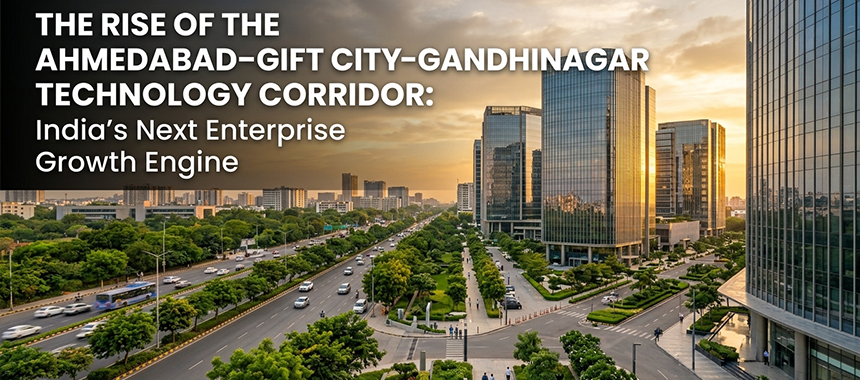
SG Highway: Ahmedabad’s Commercial Growth Spine
Within this larger corridor, SG Highway has emerged as one of Ahmedabad’s most important commercial and enterprise growth zones.
Over the years, SG Highway has transformed from a peripheral roadway into a premium urban business corridor that connects:
Its strategic value is strengthened by seamless connectivity to:
For enterprise occupiers, this connectivity is a major competitive advantage.
A business district succeeds not only because of its office buildings, but because employees, leadership teams, clients, and stakeholders can access it efficiently and comfortably.
SG Highway is increasingly becoming that enterprise connector.
Infrastructure Is Becoming the New Competitive Advantage
In the past, office location decisions were primarily driven by rental cost and space availability.
Today, enterprise requirements are far more sophisticated.
Global companies now evaluate locations based on:
As a result, infrastructure quality is becoming one of the most important differentiators in commercial real estate.
The Ahmedabad–GIFT–Gandhinagar Technology Corridor is gaining momentum because it enables enterprises to think beyond short-term occupancy and focus on long-term scalability.
For GCCs and technology companies, this distinction is especially important.
Modern workplaces are no longer just operational offices — they are innovation hubs, delivery centers, strategic business units, and talent ecosystems.
They require infrastructure that supports that ambition.
Why the Corridor Matters for GCCs
Global Capability Centers are becoming one of India’s strongest drivers of enterprise growth.
As enterprises expand their India operations, they are increasingly looking beyond traditional metro cities due to:
This is where Ahmedabad’s value proposition becomes increasingly compelling.
The city offers:
For GCCs, these advantages create significant long-term operational value.
The future of GCC expansion in India will likely be distributed across multiple high-potential business ecosystems — and Ahmedabad is well positioned to be part of that future growth map.
The Growing Importance of Grade A Commercial Infrastructure
For the corridor to reach its full enterprise potential, high-quality commercial infrastructure will be essential.
Global occupiers increasingly expect Grade A developments that provide:
This is where integrated developments such as Million Minds Tech City become highly relevant.
Located on SG Highway, Million Minds Tech City represents the next generation of enterprise infrastructure — combining:
Such developments are aligned with what modern global occupiers increasingly seek.

From Office Space to Enterprise Ecosystems
One of the biggest shifts in commercial real estate today is that enterprises are no longer simply leasing office space — they are selecting ecosystems.
For GCCs, consulting firms, technology companies, and enterprise occupiers, the workplace must support:
This is why integrated business districts are increasingly preferred over standalone office towers.
The Ahmedabad–GIFT–Gandhinagar corridor is uniquely positioned to support this transition because it combines:
Western India’s Next Enterprise Growth Story
Western India has historically been central to:
Today, the region is entering a more technology-led and services-driven growth phase.
With:
the enterprise map of Western India is becoming increasingly diversified.
Ahmedabad’s advantage lies in its ability to combine business competitiveness with urban quality of life — a combination that is becoming increasingly valuable for global enterprises.
Future Outlook
The Ahmedabad–GIFT–Gandhinagar Technology Corridor is still in a critical growth phase, but the long-term direction is becoming increasingly clear.
Over the next decade, the corridor is expected to witness strong growth across:
As enterprise activity expands, demand for the following will continue to rise:
The cities that succeed in attracting global enterprises will be those capable of offering complete ecosystems — not just office buildings.
Ahmedabad is steadily moving in that direction.
Final Thoughts
The Ahmedabad–GIFT–Gandhinagar Technology Corridor is far more than a geographic connection between three urban centers.
It is rapidly evolving into one of India’s most promising enterprise growth ecosystems.
With:
the corridor possesses the foundation required to support the next generation of enterprise expansion in India.
For GCCs, technology companies, fintech firms, financial institutions, and global occupiers, this corridor offers a rare combination of:
As India’s enterprise growth story becomes increasingly distributed, the Ahmedabad–GIFT–Gandhinagar corridor is positioned to play a defining role in Western India’s next economic chapter.
Frequently Asked Questions
The corridor combines Ahmedabad’s commercial strength, Gandhinagar’s planned governance ecosystem, and GIFT City’s international financial services platform to create a powerful enterprise growth region.
Yes. Ahmedabad offers improving Grade A office infrastructure, competitive operating costs, strong connectivity, quality urban living, and proximity to GIFT City.
SG Highway connects Ahmedabad with Gandhinagar and GIFT City while offering access to premium office spaces, residential zones, hospitality assets, healthcare, retail, and urban infrastructure.
Industries such as GCCs, fintech, BFSI, IT/ITES, consulting, engineering, R&D, and enterprise support services can benefit significantly from the corridor’s infrastructure and ecosystem.
Million Minds Tech City represents a next-generation integrated commercial ecosystem on SG Highway designed to support scalable, sustainable, and future-ready enterprise growth.